
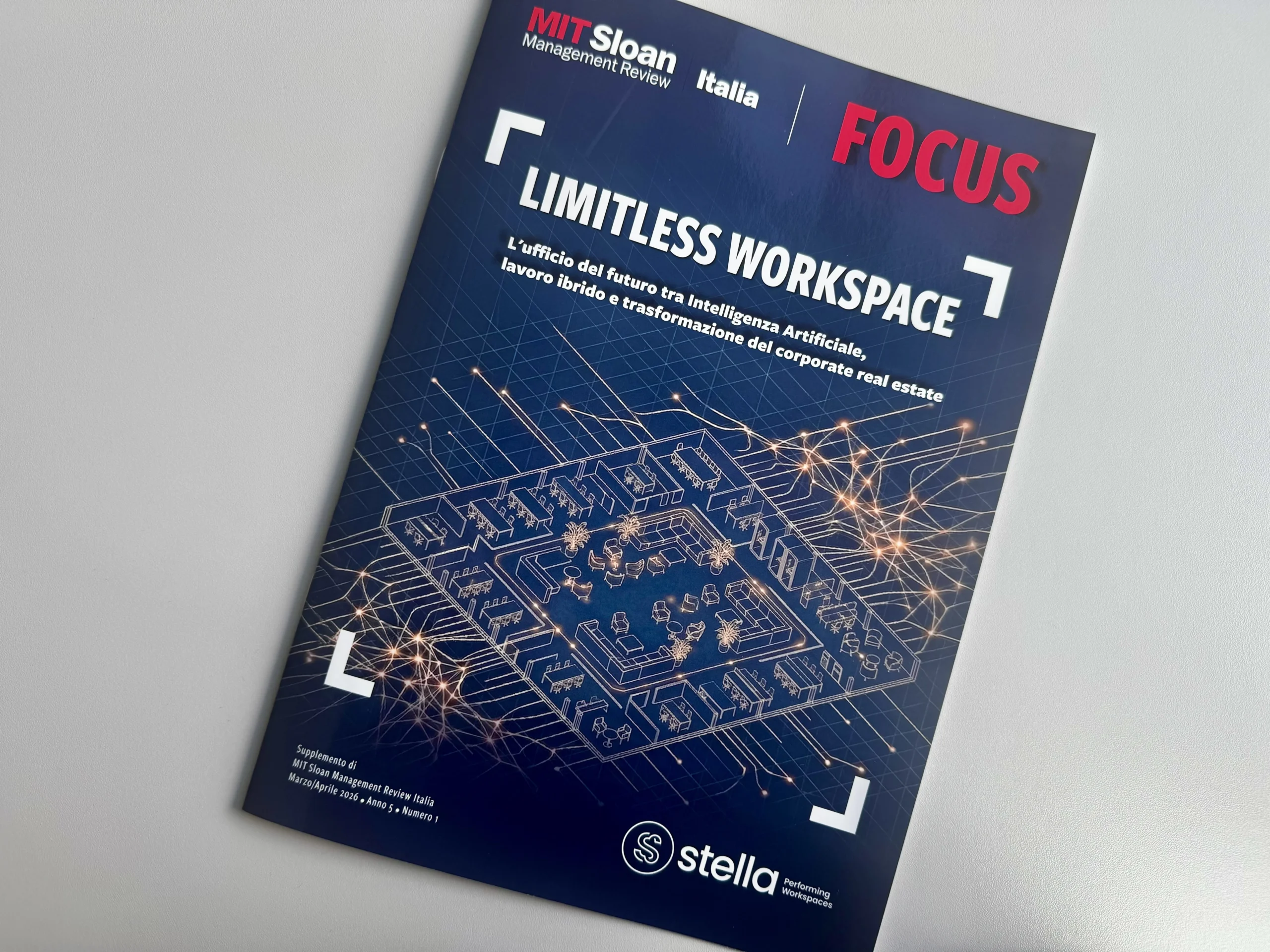
Stella33 curated the Limitless Workspace supplement on behalf of Edizioni Este, published in the March–April 2026 issue of MIT Sloan Management Review Italia. The project brought together years of field analysis, global flex workspace trends, the repositioning of complex assets, and the management of advanced work environments across different contexts, combining them with the rigor of academic sources and leading industry operators.
Pietro Martani, CEO and founder of Stella33, oversaw the editorial direction together with Andrea Guida, workplace innovation expert on the team. The conversation brought together leading voices from CBRE, Cushman & Wakefield, Politecnico di Milano, Lendlease, DILS and Quadrifoglio Group, offering a 360-degree view of what the office is becoming and why this change is structural.
Three revolutions in a decade
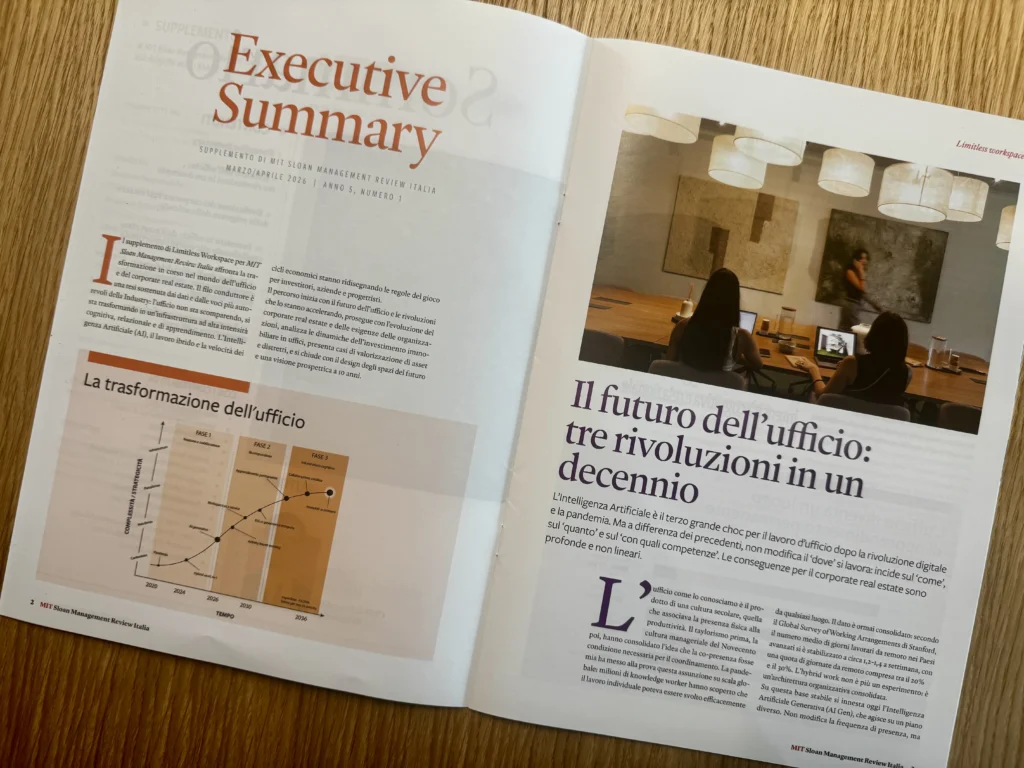
The common thread running through the supplement begins with a historical perspective: the office as we have known it is the product of a management culture that for decades associated physical presence with productivity. That culture has undergone three profound disruptions in less than ten years.
The first was digitalization, which progressively decoupled individual work from place. The second was the pandemic, which turned what had previously remained a theoretical possibility into a mass experience: millions of knowledge workers discovered that individual work could also function from home. The data confirms it: the global average has stabilized at around 1.2–1.4 days of remote work per week in advanced economies.
The third revolution is generative artificial intelligence. It is changing how work is done, how much of it is done, and which skills are required, reshaping the very nature of the activities carried out in the office. Goldman Sachs estimates that AI could automate up to 25% of work tasks in advanced economies; the McKinsey Global Institute indicates that by 2030 up to 30% of hours worked in the United States could be automated. The International Monetary Fund estimates that around 40% of jobs worldwide are exposed to AI-driven transformation.
“Major technological cycles transform work, shifting it toward activities that are more cognitively and relationally intensive. It happened with the mechanical loom, with the spreadsheet—and it is happening again.”
Economic history, however, suggests caution toward linear interpretations. In many law firms, automation of document review has already reduced the time required for preliminary analysis by 60–70%, while the remaining work requires more judgment, more interaction and greater synthesis skills. Workspaces are changing accordingly: fewer individual workstations, and more environments dedicated to collaboration, learning and services.
CBRE data confirms this: in 2025, individual workspace had fallen to 35% of total floor area, compared with 56% in 2021, while support spaces and amenities had grown significantly.
Corporate real estate as a strategic variable
One of the most substantial reflections in the supplement concerns the paradigm shift in the management of corporate spaces. The office has emerged as a strategic lever for attracting talent, building organizational culture and enabling performance.
Andrea Guida identifies three sources of complexity that corporate real estate must address today. The first is variability in use: a space designed around statistical averages is inadequate during peak periods and wasteful when utilization is lower. The second is cost layering: rent is the visible item, but the real cost is far more complex, including facility management, technology, furniture, energy, maintenance and indirect costs that are rarely aggregated. The third is the structural misalignment between space and organization: companies evolve at a pace that real estate contracts and physical layouts struggle to match.
The response to this complexity is known as Workspace as a Service: flexible environments with agile contracts, focused on experience, and closer to a club or a trusted hotel than to a traditional office. This is the model Stella33 has developed in its Business Centers at Milan Santa Giulia (Spark District), The Hive at MIND Milano Innovation District, and Palazzo Isola Nova in Venice.
The Eli Lilly case, presented in the supplement through the perspectives of Marco Benvenuti and Tiziana Lansione, illustrates how this approach can also work for large corporations: the decision to operate in a multi-tenant flex environment such as Stella Santa Giulia reflects the desire to align the space with specific operational needs, foster agility and encourage cross-pollination between different organizational cultures, for reasons that go far beyond logistical considerations.
The investment market: selective recovery and a new hierarchy of value
After several difficult years, with global office investment volumes falling by more than 40% between 2019 and 2023, the signs of recovery in 2025–2026 are clear. CBRE data indicates that average office occupancy has reached 53% globally, with peaks of up to 80% in some markets.
The recovery is selective, however. The polarization between prime assets in CBDs and secondary properties in peripheral areas remains pronounced. In Milan, the most sought-after markets maintain vacancy rates of 1% for Grade A product, with prime rents close to €850 per sqm per year. In Rome, the availability of premium product in the historic center stands at 0.55%.
In this context, flex has become established as a structural component of the asset. JLL estimates that flexible spaces now account for 5% of global office stock, with projections indicating growth to 8–10% by 2030. Integrating a flex operator into a multi-tenant building means adding a layer of services that enhances the attractiveness of the entire asset and creates connections between different tenants.
The case of Palazzo Isola Nova in Venice, 18,000 sqm that remained inactive for more than twenty years in the heart of the lagoon, demonstrates this clearly. Stella33 worked with Investire SGR to structure a three-phase strategy: commercial subdivision of the asset, branding and communication to position it as a unique professional destination within the lagoon context, and the development of a business center and clubhouse to attract small companies and professionals alongside traditional tenants.
Designing for the future: ABW, culture and continuous learning
The office of the future is a cognitive, relational and learning infrastructure. The principles of Activity-Based Working (ABW)—different spaces for different activities, no assigned workstations, and environments that support both focus and collaboration—have moved beyond experimentation to become the dominant model: CBRE 2026 reports that ABW concepts doubled their adoption in just one year, rising from 17% to 40% of the projects analyzed.
The critical point, as Katia Gentilucci of Progetto CMR emphasizes, is the organizational culture that the layout must express and support. ABW works only where there is trust, autonomy and clarity of objectives. Only 15–16% of organizations invest in training managers and employees on how to manage hybrid work, despite widespread awareness that this training would have a significant impact on performance.
The question Stefano Carone of ilPrisma asks is the right one: why should people choose to go to the office if work can happen anywhere? The answer lies in the meaning of the experience: interaction, learning, culture building and creative collisions. These are the dimensions that give physical space its value and influence engagement, sense of belonging and organizations’ capacity for innovation.
Limitless Workspace: an ecosystem of resources open to everyone
One of the most significant aspects of this collaboration is the continuity it has been able to create. The print publication has evolved into a permanent digital ecosystem: limitlessworkspace.com
A dedicated website offering in-depth content on the future of workspaces, continuously updated with analysis, data and interactive tools. Among the tools available:
→ Economic Efficiency Score — assesses the real economic efficiency of an office space, going beyond cost per square meter to include hidden costs and the value generated by the work environment.
→ Workspace Alignment Index — measures the degree of alignment between an organization’s current workspace and its actual operational and cultural needs.
→ White Paper — Stato dell’Ufficio nel 2026 — a summary of the data, trends and perspectives developed in the supplement, available free of charge.
Working on this project meant bringing together years of hands-on experience, analysis of global flex workspace trends, the direct management of complex assets, and daily engagement with companies seeking concrete answers to increasingly difficult questions, and turning all of this into a contribution designed to remain useful over time. The office continues to evolve. And continuing to understand how to make that evolution work well is the work we do.
Contact us to find out more: