

Quick summary
- Total Cost of Occupancy (TCO): the sum of all the costs associated with an office, including rent, operating expenses, fit-out, services, technology, and the hidden costs that rarely appear under a single line item in the budget.
- In most companies, office costs are fragmented across different contracts, suppliers, and departments, making it easy to underestimate the true cost of the workplace.
- For a company with 6–12 employees, in the same area of Milan, a serviced office can reduce occupancy costs by around 30% compared to a traditional lease, thanks to the elimination of upfront investment, day-to-day operational management, and unexpected expenses.
- Those managing the workspace should start by looking at the total cost, rather than just the rent, when deciding between a traditional lease and a serviced office.
Workspace managers should consider total costs, not just rent, when choosing between a traditional lease and a serviced office.
The true cost of your office is almost always higher than the rent stated in the contract. Beyond the rent, there are shared expenses, utilities, maintenance, cleaning, reception, meeting rooms, connectivity, furniture, and internal time spent on tasks unrelated to your core business. The sum of all these costs is known as the Total Cost of Occupancy. Calculating it fully is the first step to understanding whether your current office is truly working in your favor.
What is Total Cost of Occupancy
The Total Cost of Occupancy (TCO) measures everything a company spends to occupy and operate its workspace throughout the entire period of use. It includes explicit costs, first and foremost rent, as well as all related expenses such as operational services, technology, fit-out, and indirect costs that often remain hidden.
The concept originated in the corporate real estate sector and is now one of the key metrics closely monitored by CFOs, as office costs are often among the most significant items in the income statement, second only to personnel expenses. According to the analysis by [ ], a workspace evolution advisory platform, the real challenge for companies is not only how much the office costs, but also how manageable that cost is.
Why rent only tells part of the story
Anyone evaluating an office by looking only at the price per square metre is only seeing the beginning of the story. Rent is the most visible and easiest cost to compare, which is why it often drives the decision-making process. However, the true cost impacting the balance sheet includes much more.
Three weaknesses are common across almost all companies:
- Data fragmentation: expenses are spread across rent, facilities, technology, services, human resources, and indirect costs, and are rarely consolidated into a single, coherent overview.
- Misalignment between cost and usage: many companies still pay for office spaces designed for full occupancy, while hybrid work has reduced the actual use of available square metres.
- Hidden costs: from operational inefficiencies to the time spent on non-core activities and administrative tasks.
Limitless Workspace identifies these three factors as the reason why many office-related decisions are made based on incomplete information.
The five components of the true cost of an office
To fully understand the Total Cost of Occupancy, it is useful to group it into five main cost categories.
- Direct real estate costs
Rent, operating expenses, and service charges. These are the most visible costs and the easiest to forecast.
- Operational costs
Utilities, maintenance, cleaning, reception, and day-to-day workspace management. In a traditional lease, these costs are entirely the company’s responsibility and are managed through separate contracts.
- Technology costs
Connectivity, IT infrastructure, booking systems, access control, and digital tools for workspace management.
- Capital costs (CAPEX)
Fit-out, furniture, systems, and adaptation works. These represent an upfront investment that impacts a long-term lease from day one, even before the office becomes fully operational.
- Indirect and opportunity costs
The hardest costs to quantify: internal time spent managing the office, underutilized spaces, and limited flexibility when the team grows or downsizes. Limitless Workspace refers to these as hidden cost exposure and identifies them as the portion that most often remains out of control.
Hidden costs: the portion of expenses that escapes control
Hidden costs deserve a dedicated section because they are what make the difference between an estimate and a reliable calculation.
- A large meeting room used only a few hours a week is space you are paying for but not fully using.
- A team that spends entire days coordinating cleaning suppliers, maintenance providers, and connectivity contracts is using valuable time that could be dedicated to core business activities.
- A rigid lease that prevents a company from reducing or expanding its office space as the team changes creates an opportunity cost that never appears on any invoice.
Making these costs visible is exactly the goal of a thorough Total Cost of Occupancy calculation. The value of this exercise lies in bringing to light what usually remains hidden.
How Stella33 makes Total Cost of Occupancy predictable
Stella33 designs work ecosystems that integrate space, services, technology, and community into a single serviced office solution. For workspace managers, this translates into a Total Cost of Occupancy that is easier to understand, predict, and manage.
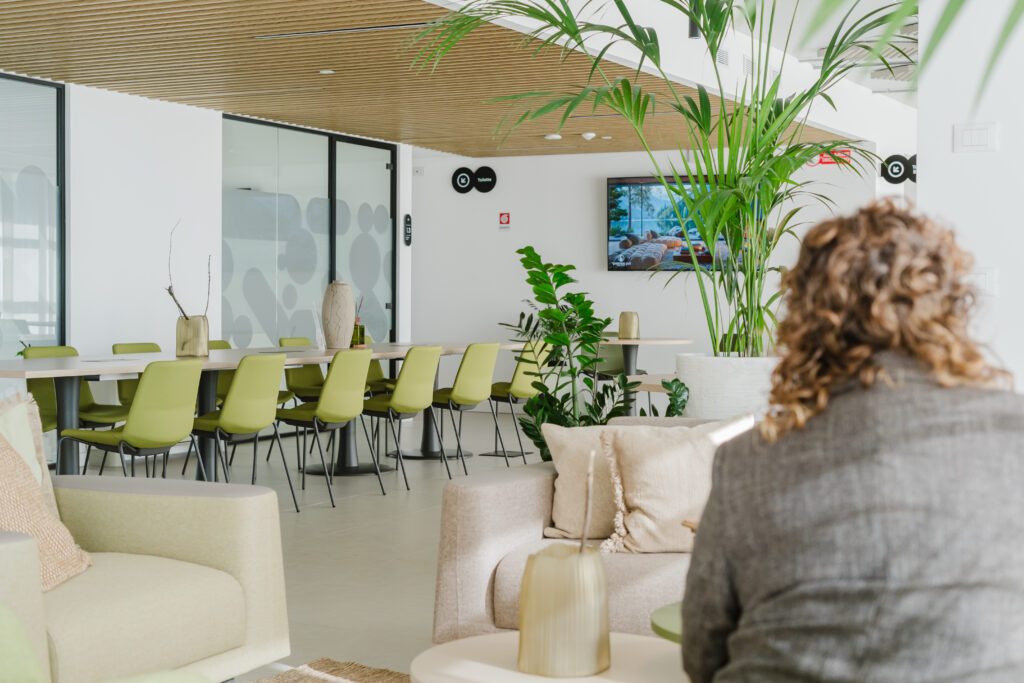
Stella33’s offices for rent in Milan come fully furnished and ready to use, with services included in a single fee: reception (managed according to the Stella33 house management approach), meeting rooms, lounges, phone booths, connectivity, and digital workspace management through an app. The costs that, in a traditional lease, are spread across multiple suppliers are consolidated into a single invoice, with expenses aligned with the actual use of the space. The upfront investment in fit-out and furniture is absorbed by the serviced office model, freeing up capital that can be allocated to the business.
|
The principle behind our approach is simple: every workspace is a strategic asset for a company, and office costs become a clear, predictable figure aligned with how the space is actually used. |
An applied example: a 6–12 person team in Milan
Let’s imagine a nine-person company evaluating two options in the same area of Milan: a traditional leased office and a Stella33 serviced office.
Traditional lease
The budget starts with the rent, but the true cost grows item by item: service charges, initial fit-out, furniture, connectivity contracts, cleaning, maintenance, and the share of internal time someone in the company will need to dedicate to managing it all. On top of this comes the constraint of a long-term lease, typically 6+6 years, based on a fixed amount of space.
Stella33 serviced office
The fee includes furniture, services, technology, and management. Meeting rooms are charged based on actual usage, and the workspace can expand or shrink as the team changes. In the same area, for a company of this size, a serviced office can deliver average savings of around 30% on Total Cost of Occupancy, by eliminating upfront investment, fragmented operational management, and a significant share of hidden costs.
Stella33 data: companies with 6–12 employees, compared within the same area. Figures to be verified against the client’s specific contractual scope.
Checklist: the questions to ask before signing
- Do I know my complete Total Cost of Occupancy — beyond just rent — including services, technology, and indirect costs?
- How much of my office space is actually being used compared to the amount of space I am paying for?
- What is the ratio between fixed and variable costs in my current contract?
- How much internal time do we dedicate to the operational management of the workspace?
- Does my contract allow me to adjust the office space if the team grows or shrinks?
Do you want to know the true cost of your office?
Measuring the Total Cost of Occupancy is the first step to understanding whether your workspace is working in your favour. Limitless Workspace, an advisory platform and partner of the Stella editorial ecosystem, has developed the Economic Efficiency Score, a free tool that measures the financial health of your workspace.
When you want to turn that result into a concrete solution, iscover the Stella33 offices in Milan or explore the included services: our team will help you understand your total cost and make it predictable.
FAQ
Is Total Cost of Occupancy only relevant for large companies?
No. It applies to any organization that occupies a workspace. For SMEs and startups, it can be even more relevant, because hidden costs have a greater impact on a leaner structure.
Is a serviced office always more cost-effective than a traditional lease?
It depends on the Total Cost of Occupancy calculated for the specific case. For small and medium-sized teams that value flexibility and included services, the serviced office model tends to reduce the overall cost. The right approach is to compare the two TCOs within the same area.
How can I measure the true cost of my office?
The first step is to bring all cost items together into a single overview. Tools have been developed specifically for this purpose: Limitless Workspace’s Economic Efficiency Score allows you to assess how transparent and manageable your workspace costs are.
Sources and further insights
- Limitless Workspace, «Economic Efficiency Score (EES): The CFO’s Framework for Managing Office Real Estate Costs», Pietro Martani, aprile 2026. . limitlessworkspace.com
- McKinsey & Company, “Six New Imperatives for Real Estate Players,” March 2023 (focus on operational efficiency and value creation throughout the asset lifecycle).
- McKinsey & Company, “Six New Imperatives for Real Estate Players,” March 2023 (focus on operational efficiency and value creation throughout the asset lifecycle).
- Stella33 Workspace, official website and Resources section. stella33.com/risorse/